
REVIEW · LOMBOK
2D1N Senaru Crater Rim Trekking
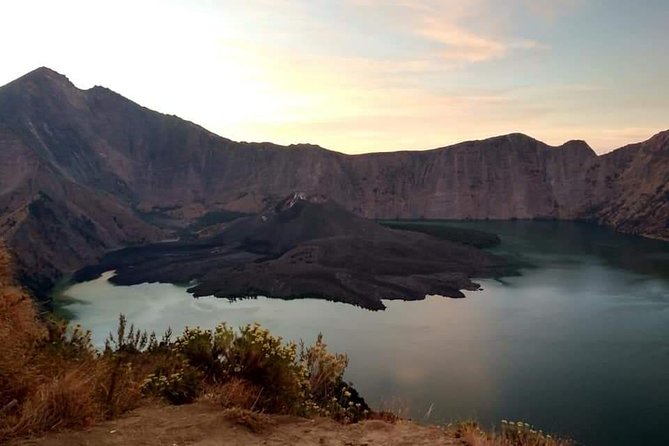
Mount Rinjani’s Senaru route gives you the mountain’s big reward without attempting the summit. In two days, you climb from tropical forest at 601 meters to a campsite at 2,641 meters, then wake above the clouds for sunrise over Segara Anak Lake, the volcanic cone, Bali, and the Gili Islands. The views are the main event, but the climb is no casual forest walk.
I especially like the private format, since your guide can adjust the pace to your group, and I like that porters carry the tent, cooking gear, food, and water. The camp includes a mattress, pillow, sleeping bag, and toilet tent, which matters after a long uphill day. The catch is simple: this is still a hard trek, with more than 2,000 meters of ascent on day one, and the national park fee, transport, trekking shoes, rain gear, gloves, and headlamp cost extra.
The important points at a glance
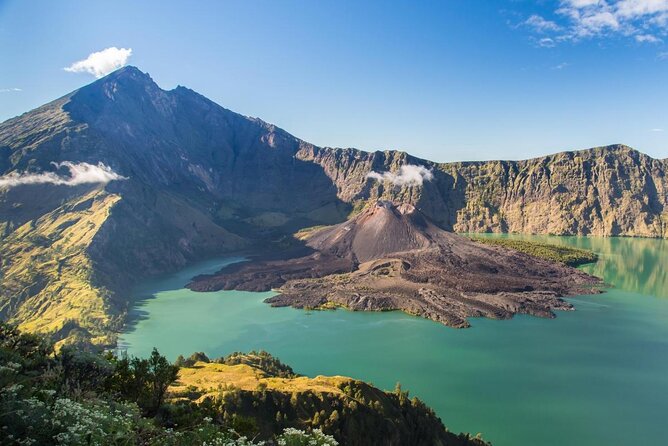
- The climb reaches 2,641 meters, not Mount Rinjani’s 3,726-meter summit.
- Day one is the hard day, with forest walking, steep grassland, and more than 2,000 meters of ascent.
- Sunset looks toward the Gili Islands and Mount Agung on Bali, while sunrise brings views of Segara Anak Lake and the volcanic cone.
- Porters carry the camping and cooking equipment, while you carry your personal day items.
- The private group sets the pace, with guides including Anton, Lim, Rudy, Benji, and Mario assigned across different departures.
- The listed price is $156 per person, but add the Rinjani park fee of IDR 250,000 per person per day and arrange transport separately.
What you are really signing up for
This is the shorter and less demanding way to experience Mount Rinjani, but shorter does not mean easy. The route starts at Senaru, on the north side of Lombok, and climbs through several zones in a single day. You begin in thick tropical forest, then move into more open grassland before reaching the crater rim.
The key figure is the ascent. Starting at 601 meters and camping at 2,641 meters means gaining roughly 2,040 meters in elevation. That is a serious uphill day, especially in warm weather and on uneven ground. The operator describes the required fitness level as moderate, but I would treat that as a minimum, not a promise of an easy outing.
You do not need to carry the tent, cooking equipment, or food. Porters handle those supplies, and the package provides three liters of mineral water per person per day. You still need to carry your own small personal load, including anything you need during the walking hours.
This private setup is useful if one person in your group walks more slowly, needs regular rests, or wants to keep moving without being tied to a large public group. It also lets your guide adjust the rhythm. Guides named in the supplied material include Anton, Lim, Rudy, Benji, and Mario. The quality of your day will depend partly on which guide and porter team you receive, but the strongest praise centers on encouragement, care, food, and pacing.
More Volcano Crater Hikes in Indonesia
- Mount Rinjani 2 Days 1 Night Senaru Crater Rim
★ 5.0 · 131 reviews - Mount Rinjani 2-Day Trek to Senaru Crater Rim
★ 4.8 · 89 reviews - Mt. Rinjani 2D1N Senaru Crater Rim
★ 5.0 · 75 reviews
Day one: Senaru forest to the crater rim
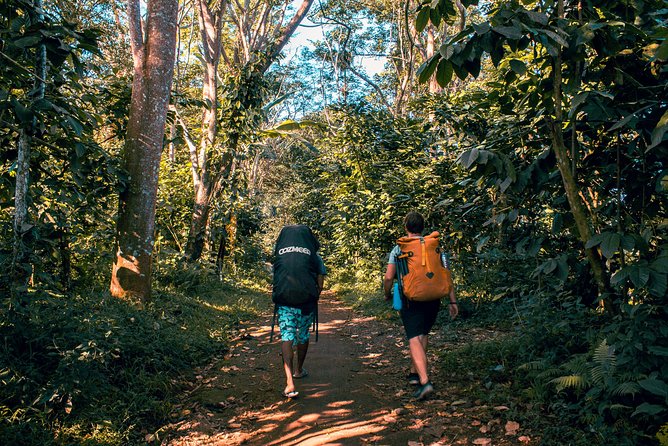
You meet at the Lombok Volcano Trekking office in Senaru at 7:00 a.m. The formal starting point is the Rinjani Trek Centre, at about 601 meters. The walk begins in dense tropical forest, a welcome change from the exposed upper slopes that come later.
The first rest points are Pos 1 and Pos 2. These breaks are not just decorative stops. They divide a long day into manageable sections and give you time to drink, eat, and check how your legs are holding up. You should use them well. A private guide can set a comfortable rhythm, but the mountain still demands steady effort.
Lunch comes at Pos 3, around 2,000 meters. By this stage, you have already gained most of the day’s height, and the character of the route changes. The trees give way to grassland, and the trail becomes steeper as it approaches the Senaru Crater Rim.
The final push is where the trek feels most demanding. You are higher, tired, and more exposed. The prospect of the campsite helps, but do not expect to race the clock. The tour is private, so your group can take the pace that suits you, within the limits of daylight and the guide’s judgment.
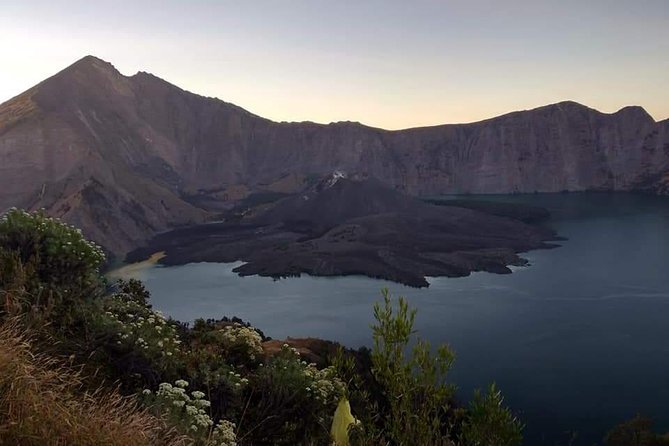
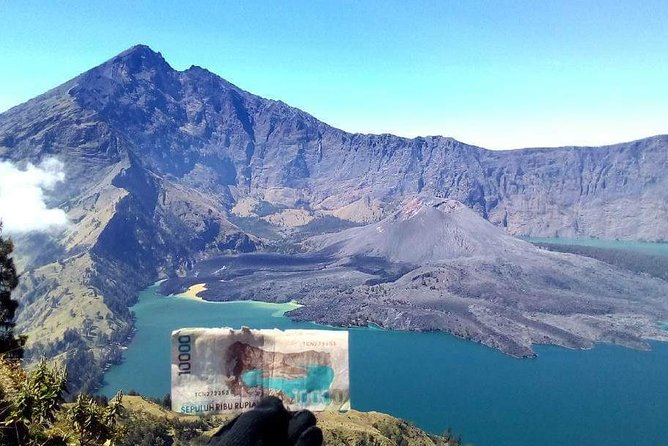
At the rim, the effort pays off quickly. The campsite sits at about 2,641 meters, with views toward Mount Rinjani’s summit, Segara Anak Lake, and Gunung Baru, the volcanic cone inside the wider caldera. Looking outward, you may see Mount Agung on Bali and the Gili Islands.
Sunset is a major reason to choose this route. You are not simply walking to a high camp and going to bed. You get a good chance to watch the light fall across the sea toward Bali and the Gili Islands, with Mount Agung adding another volcanic outline to the view.
Camping at 2,641 meters
The camp is more practical than luxurious, but it includes the basics that make a real difference. Your team sets up a tent with a mattress, pillow, sleeping bag, and toilet tent with paper. After a steep day, a thicker mattress and warm sleeping bag are not small comforts.
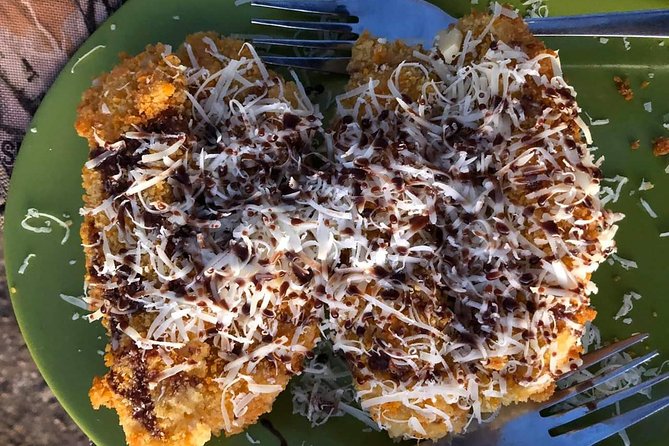
The porters also carry the cooking equipment and prepare meals. Food is included, along with drinking water and snacks during the trek. Several descriptions of the experience praise the quantity and quality of the meals, including good vegetarian adjustments. You should still tell the operator about dietary needs before you go, since the supplied information confirms that vegetarian meals can be arranged but does not list every possible diet.
The toilet tent is basic. It gives you privacy at camp, not indoor plumbing. That is worth knowing before you book. You are spending the night on a volcanic rim, so the right comparison is supported mountain camping, not a hotel with a view.
The temperature can feel very different from the heat below. The package includes bedding, but you should bring suitable warm layers. A rain jacket is also on the required personal equipment list, even if the forecast looks kind. Weather can change, and one of the supplied accounts describes a beautiful trip despite rain.
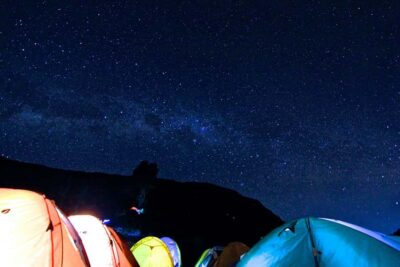
Your evening is likely quiet and simple: eat, look at the stars or the lights below if conditions allow, and rest for the early morning. The camp’s location matters more than its comforts. A tent beside the crater gives you a rare view before the trail gets busy and before the sun comes up.
Day two: sunrise, breakfast, and the long walk down
The second morning starts with sunrise at the rim. The views can include Segara Anak Lake, Mount Rinjani’s summit, and Gunung Baru. This is the moment that makes the first day’s climb feel worthwhile, particularly if you have chosen the crater rim because you want scenery rather than the additional effort of reaching the summit.
After sunrise, you have a relaxed breakfast before packing for the descent. The route back to Senaru is the same broad journey in reverse, but downhill walking has its own problems. Your knees and ankles take more impact, and loose or uneven sections require care.
The group stops for snacks along the route and has lunch at Pos 2. You are expected to reach Senaru at around 1:00 p.m., returning to the original meeting point. The activity does not include pickup before the trek or onward transfer afterward, so you need to arrange those separately.
This return schedule is useful if you have another Lombok plan later in the day, but I would avoid making an important connection immediately afterward. The descent time is an estimate, and mountain walking can slow down because of weather, tired legs, or rest stops.
More Volcano Hikes and Treks in Indonesia
- Bali: Sunrise Mount Batur Guided Hike with Breakfast
★ 4.8 · 9,660 reviews - Bali: Mount Batur Sunrise Guided Hike and Natural Hot Spring
★ 4.8 · 9,284 reviews - Bali: Mount Batur Sunrise Trek With Guide and Breakfast
★ 4.8 · 3,461 reviews - Mount Batur Sunrise Hike and Natural Hot Spring Option
★ 5.0 · 1,927 reviews
Why the private guide matters
A private trek is not the same as a private mountain. You still follow the established route and deal with the same steep slopes, weather, altitude, and rough footing. The benefit is control over your group’s pace and attention.
That matters most on day one. Some people will find the climb manageable, while others will need more frequent stops. A private guide can respond to that without forcing your group to match strangers. The guides praised in the supplied accounts, including Lim, Anton, Rudy, Benji, and Mario, are described as encouraging, attentive, and willing to share information about the natural setting.
The porters are a major part of the experience. They carry the tent, sleeping equipment, cooking supplies, food, and water up and down the mountain. That support makes the route possible for many people who could not manage it with a full pack.
You should remember that porter support does not remove the physical challenge. You still walk the entire route, and the climb is steep. A fair tip is worth planning for because the porters do the heavy work that keeps the camp operating. The supplied details specifically encourage tipping the guides and porters for their effort.
The price and what it does not cover
At $156 per person, this package offers solid value if you want a supported overnight trek rather than an independent camping trip. You are paying for a private guide, professional porters, meals, water, tent, sleeping bags, mattresses, pillows, toilet equipment, and luggage storage at the trekking office.
The Rinjani National Park fee is extra at IDR 250,000 per person per day. For a two-day trek, that is IDR 500,000 per person if the daily fee applies to both days. Transport is also excluded, including pickup before the trek and transfers after it.
You must bring or arrange your own trekking shoes, rain jacket, long pants, gloves, and headlamp or hand torch. These are not minor extras. Good footwear and a light are basic safety tools on a route that begins early, ends in camp, and may be wet.
Accommodation before the trek is not included either. If you are staying elsewhere on Lombok, ask about your route to Senaru and leave enough time to reach the 7:00 a.m. meeting point. The operator offers luggage storage at the Lombok Volcano Trekking office, which is handy if you do not want to carry your main bag up the mountain.
The price is strongest for people who already have suitable clothing and footwear and who value the private format. If you need to rent or buy several items and add transport, your total cost will be higher than the headline figure.
Who should choose this route
I would recommend it to someone with moderate fitness who wants a major Lombok mountain experience but does not want the longer summit trek. It also suits couples, families with older children, and small private groups that want the flexibility to stop when needed.
A family with children aged 10 and 12 completed the route, but the walk still required persistence. That is a useful warning. Children may manage it, yet the height gain and long uphill day should not be treated as a simple family hike.
This is not the right pick for someone seeking a gentle nature walk, a comfortable camping holiday, or a flexible cancellation policy. The booking is non-refundable and cannot be changed after purchase. You should be confident about your dates, fitness, and equipment before paying.
The route is also not for someone whose main goal is to stand on Mount Rinjani’s summit. This trip finishes at the crater rim around 2,641 meters. The summit is about 3,726 meters and requires a longer itinerary. The crater-rim trip gives you the lake, cone, Bali, and Gili views without adding that final summit push.
Practical preparation for the climb
Train for sustained uphill walking rather than speed. The best preparation is regular climbing or stair work, along with enough walking to be comfortable on a long day. You do not need to sprint, but you do need to keep moving for hours.
Pack light, since the porters carry the shared equipment but not every personal item. Bring the required trekking shoes, long pants, gloves, rain jacket, headlamp or hand torch, and any personal medication. Keep water and snacks within easy reach.
Use the rest stops properly. Drink regularly, eat before you feel empty, and tell the guide early if you need to slow down. A private tour works best when you communicate clearly instead of trying to hide fatigue.
Allow some flexibility around the 1:00 p.m. return time. The listed schedule is useful, but this is a mountain trek, not a train journey. Weather, trail conditions, and the group’s pace can all affect the descent.
Should you book the Senaru crater-rim trek?
Book it if you want Rinjani’s great views in two days, appreciate having a guide and porters, and accept one very demanding uphill day. The sunset toward the Gili Islands and Mount Agung, followed by sunrise over Segara Anak Lake, gives this shorter route real scenic power.
Skip it if you want a light walk, need a refundable booking, or cannot manage a 2,000-meter ascent. Before booking, add the two-day park fee, transport, personal equipment, and any accommodation in Senaru to the $156 price.
For the right person, this is a strong value and a memorable way to see Mount Rinjani. Just respect the climb. The mountain does not care that the trip is called two days.
FAQ
How high does this trek go?
The trek reaches the Senaru Crater Rim at about 2,641 meters. It does not continue to Mount Rinjani’s summit, which is around 3,726 meters.
How difficult is the trek?
The operator describes it as suitable for people with moderate physical fitness, but day one includes more than 2,000 meters of ascent. Expect a demanding uphill walk through forest and steep grassland.
What time does the trek start?
You meet at the Lombok Volcano Trekking office in Senaru at 7:00 a.m. The trek begins after registration at the Rinjani Trek Centre.
Are food and camping equipment included?
Yes. The package includes food, three liters of mineral water per person per day, a tent, toilet tent and paper, sleeping bags, mattresses, and pillows. Porters carry the cooking and camping equipment.
What extra costs should I plan for?
The Rinjani National Park fee is IDR 250,000 per person per day. Transport, accommodation before the trek, trekking shoes, rain jacket, long pants, gloves, and a headlamp or hand torch are not included.
Does the tour return to Senaru?
Yes. After sunrise and breakfast on day two, you descend to Senaru, stop for snacks and lunch, and are expected to return to the meeting point at around 1:00 p.m.
More 2-Day Experiences in Indonesia
- From Surabaya / Malang : Mt Bromo Sunrise – Ijen Blue Fire 2D1N
★ 5.0 · 330 reviews - From Malang: Shared Mount Bromo & Ijen Tours Start – 2D1N
★ 4.4 · 171 reviews - 2Days – Bromo Sunrise Ijen Adventure via Malang
★ 5.0 · 152 reviews - Bali: 2-Day Sunset and Sunrise Camping at Mt. Batur
★ 4.6 · 124 reviews
Just added around Indonesia
- From Banyuwangi or Bali Sunrise Ijen Vulcano Hiking All Inclusive★ 5.0 · 50 reviews
- Ijen Blue Fire & Sunrise Sharing Tour★ 5.0 · 6 reviews
- Kawah Ijen Midnight Tour (1 Day)★ 4.5 · 7 reviews
- 1 Day – ULTIMATE Tour Ijen Blue Fire From Surabaya, Malang and Banyuwangi★ 5.0 · 6 reviews
- Kawah Ijen Blue Fire Tour – Share Package★ 5.0 · 7 reviews
- Ijen Crater Tour★ 5.0 · 33 reviews
- 2 Days Private Tour Ijen and Bromo from Banyuwangi★ 5.0 · 31 reviews
- Guided Tour to Ijen Crater Blue Fire★ 5.0 · 4 reviews
Lombok Volcano Tours, compared.
Mount Rinjani 2 Days 1 Night Senaru Crater Rim
Read our review →
3D-2N Explore Mount Rinjani – Summit -Lake and Hotspring
Read our review →
Mount Rinjani: 2D/1N Trekking To Sembalun Or Senaru Views
Read our review →Browse the lists this tour appears in